Felipe Castelblanco

MEDIA ARTIST

By APNWLNS payday loans

Public Art

Public Art / Billboard

New Public Project:
Billboard in Pittsburgh Downtown (5th Ave at Stevenson St.)

Billboard Project - Pittsburgh Downtown

Y si fuere obra del destino / As if  it were a work of destiny

The iconic map of Pittsburgh drawn on the palm of the hand, following the lines of life, suggests a more intimate connection with this place, especially for those who feel they are outsiders. The image, along with the texts, seek also to motivate reflections about identity and place, while recognizing the presence—of an almost invisible—Latino population in Pittsburgh.

Share this:

Memorias de Ciudad

“Las Aguas” un lugar familiar (“The Waters” a familiar place)
Work by Felipe Castelblanco and Camilo Pachón

In the ’90s, a monument in the oldest area of Bogota used to serve as a shelter for homeless people. Now the area has passed through a gentrification process, pushing low-income and homeless people toward marginalized areas in the south of the city.

This illegal intervention reclaimed the space of the iconic monument by using typical symbols of popular habitation from the south of Bogota, such as house plants and clotheslines.
The piece converted itself into a performance when confronted by the authorities, through which each piece of clothing was taken down individually and neatly folded.

Video Stills:

Share this:

The DRIFT

http://driftpgh.com/

The Drift is a floating platform for creative projects that explore the rivers and waterfronts within the city of Pittsburgh. In the spring of 2012, a team of seven artists constructed a pair of hexagonal rafts. Since then, The Drift has hosted a series of performances, lectures, and buoyant interventions.

The DRIFT is a project by:
Steve Gurysh, Luke Loeffler, Scott Andrew, Craig Fahner, Erin Womack and Felipe Castleblanco.

The Drift is supported in part by a Seed Award from The Sprout Fund, a grant from the Awesome Foundation, as well as support from the School of Art at Carnegie Mellon University.

Share this:

Air Trafficking

Habana Air:

On February 17th, 2012, I smuggled one liter of Cuban air across the border through U.S. Customs, in direct violation of the 51-year embargo.

Ongoing actions:

Tehran, Iran
In February of 2013, another liter of Iranian air was smuggle across the border through U.S. Customs, in direct violation of the current.

This bottled air traveled inside a suitcase that came all the way from Tel Aviv, Israel, passing from hand to hand across a human network all the way from East to West.

Share this:

Temporary Monuments (Urban Intervention)

Experiments in video projection onto CMU’s heating system exhaust.

Share this:

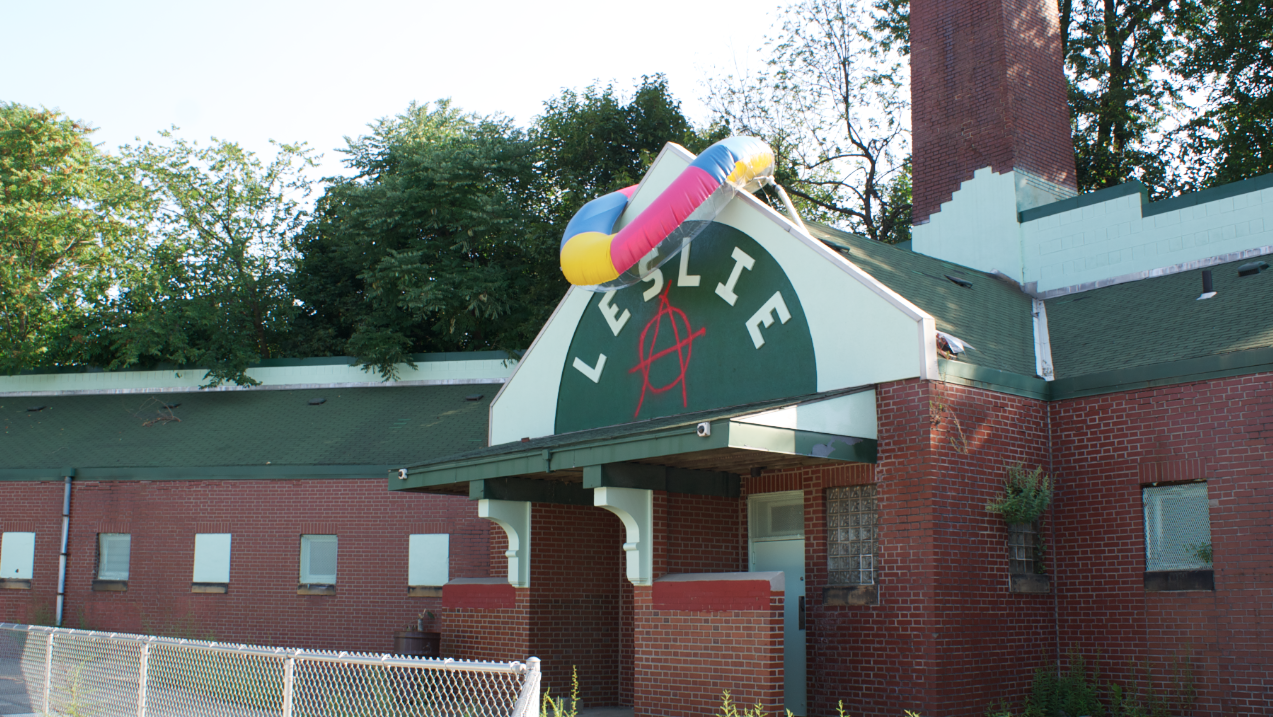
LIDO (Urban Intervention)

Leslie Pool in Lawrenceville. Pittsburgh, US.
August 2012.

This sculptural gesture seeks to engage in a humorous dialogue with the building and site (a former recreational public pool in Pittsburgh, US). The vacant building nowadays seems misplaced and even removed from its own purpose. I created this intervention as a reaction to this familiar feeling, suggesting a new image of the site that gives agency to the ongoing efforts of the community to re-purpose the building. This piece also serves as a playful homage to the irony behind neglected public spaces in US cities.

Share this:

We Paint Houses

“We paint houses” is a participatory project that takes the form of a temporary business established by Colombian artist Felipe Castelblanco and Latino laborers living in the U.S. In the first version of this project the group offered to paint people’s houses within the city of Portland, Oregon using local media and street advertisement. However, instead of painting the walls of the houses, artist and laborers create fine art paintings — on canvas — of the façades of the buildings, while engaging customers/audiences in a situation that re-imagines the act of exchange, service and labor. A temporary art studio (with easels, canvases and palettes) emerges on the streets as the group creates the paintings.

This performance explores mistranslation, misrepresentation and labor, while seeking to produce contentious encounters between locals and immigrants, workers and artists.

Share this:

Ephemeral Museum

The Ephemeral Museum of Venice, Bogotá.
http://museo.fundacionvisiva.org/

The museum was build on the roof of the Venice’s community cernter by VISIVA Foundation, Arq. César Rámirez / Arq. Christian Nieiman / Arq. Carlos Hernandez and students from Javeriana University.


The Project:

In 2009, as co-director of VISIVA, I worked on a collaborative project to build the Ephemeral Museum of Venice. The museum was constructed on the roof of an unfinished community center, using disposable materials donated by factories in the area. The collection of the museum is a series of reproductions of representative paintings from the history of art, produced by volunteer artists and art students, and its goal is to give the community access to cultural knowledge that is common for other social circles and also to generate the basis to better understand works of contemporary art.

Comunity center and Museum

www.fundacionvisiva.org

.

Context (The Biennial of Venice of Bogotá)

In a marginalized area of Bogota, there is a neighborhood called Venice. Since 2003, I’ve been part of a small collective that produces and curates a biennial urban art event modeled after the official one in Venice, Italy. It invites local and international artists to produce site-specific projects in the neighborhood, engaging the community and contextual problematics. This project has been the pioneer in Latin America in the field of relational aesthetics, and has motivated similar projects around the continent.

More Info About The Biennial of Venice of Bogotá:
http://bienal-venecia-bogota.blogspot.com/
Share this:

Mira lo que EYE


Storefront installation in the West End of Pittsburgh.
This piece was commission by Future Tenant Gallery and the West End Association for an empty Storefront in Pittsburgh, PA.

For a few days I walked around the streets of the West End, while figuring out a way to produce this project. Each of these walks implied encounters and conversations with people that work in the neighborhood, who are normally invisible for a distracted passer by. During this time I stopped in every store or business that could provide these encounters and conversations, while altering the downtime of each business and their employees.

Two TVs play continuously videos of people’s eyes looking back at viewers when performing their normal tasks in the stores. A sensor in the window, activated by pedestrians passing in front of the windows, controls two fans that blow at the curtains installed inside the storefront.

“Mira lo que Eye” (See what’s there, who’s there) is a project where the the lives of West End residents and pedestrians are confronted with close up images of people that work or spent most of their time in commercial and public spaces of neighborhood. The gaze of the participants stares continuously at the street, while resembling an almost meditative situation that moves between patient attention, surveillance and even active imagination and distraction. The installation seeks to bring back a contradictory moment into the store front, that of being present physically but mentally absent while being lost in the downtime, routine and even monotony of the street.

This installation comments on the lack of recognition for those who still remain in neighborhood.

Video Documentation:


Share this:

Warhol in the Andes

America’S Pop beyond North American borders:
A Collective re-interpretation of Warhol’s pop artworks in rural Colombia, June 2010
Related Press:  Carnegie Museums, ‘El Colombiano’ News Paper.


Warhol in the Andes

In June 2009, the largest Warhol exhibition ever to be staged in Latin America, Andy Warhol: Mr. America, was organized by The Museo de Arte del Banco de la República in Bogotá, Colombia, in partnership with The Andy Warhol Museum of Pittsburgh. During the exhibition organized by the museums, a small town called Jericó in the rural Colombian Andes, put together an independent parallel exhibition of 13 of Warhol’s works in a hybrid space (the gallery and conference room) of the local archeological museum, borrowing prints of Mao and Marilyn from the private collection by an art dealer and collector born in Jerico.

The undertaking garnered a lot of press, with one Colombian newspaper declaring “Believe it! Warhol in Jericó.” The title of this article makes explicit how amazing and unprecedented this event was for the people of Colombia, especially those living outside of the capital city who often lack access to institutions of art and cross-border cultural exchange, more generally.

Soon after moving to Pittsburgh from Bogotá and starting work at The Andy Warhol Museum, I stumbled upon a small article about  the Jericó exhibition in the Pittsburgh Post-Gazette in March of 2010. If nothing  else it was an amazing coincidence, and I wanted to use the opportunity to follow up on Jerico’s efforts to break down the cultural isolation that occurs in rural areas of my country

In June of 2010, I returned to Colombia and organized a series of workshops in Jerico about Warhol’s work and silkscreening techniques. The workshops engaged almost 300 people–including school children, local educators as well as drug-addicted youth from a nearby rehab shelter–allowing them to discuss and appropriate Warhol’s strategies by using local referents to produce portraits, collages and silkscreened T-shirts.  These workshops helped to expand  on Jerico’s sudden surge of interest in Warhol, and in art in general, as well as to create dialogue between North American Pop icons and local imagery.

Acknowledgement:

Workshop activities modeled after RUST (Radical Urban Silkscreen Team) and the ongoing programs by the The Andy Warhol Museum’s education department.

For this workshops I used the portable exposing units for silkscreen designed by Artists Image Resource (AIR), an artist-run organization in Pittsburgh that specializes in fine art printmaking.

This project was possible thanks to Andrea Solano, my workshop co-facilitator, Jerico’s Museum and Municipality, Heather White and Mary Tremonte and the education team from the Andy Warhol Museum.

Share this:

Children’s Room at the Art Museum

Children’s Room: Arte EnTresSentidos (Art Between Senses / in Three Senses).
Permanent  Installation at the main art museum in Colombia “Museo del Banco de la República de Colombia”

See more of this project by clicking here

Over one year, I did a study of the art collection of the museum and appropriated a series of works, translating their meanings, concepts and relationships to various art movements into an engaging pedagogical language, accessible to children visiting the museum. This project, titled “Arte EnTreSentidos” (“Art Between the Senses”/ “In Three Senses”), uses interactive objects and multimedia pieces that present the conceptual content of the project, being one of the first interactive rooms with free access to the public in Colombia.

As a complement to the project, I developed a program of guided visits and workshops that serve children between six and 12 years old, residents of severely marginalized and peripheral areas of the city, who are provided with free transportation to visit the museum.


Animations

Share this: